
Arrest Records in Camden County
An arrest record is the first official trail a case leaves. It is made by police or the sheriff at the moment someone is booked into custody. In Camden County, two main agencies sit behind these records. The Camden County Sheriff's Office runs a criminal identification bureau and handles court security, civil process, and prisoner transport. The Camden County Department of Corrections books people into the county jail and tracks their custody status. Local and county police make the arrest, then the jail logs the intake. The result is a record that shows the name, the booking date, the charges at arrest, and the place of custody.
An arrest record is not the same as a criminal court record, and neither one proves guilt. The arrest file marks the start. It shows what police alleged and where the person was held. Once a prosecutor files charges, a court case opens with its own docket, pleas, motions, and a final outcome. Those deeper criminal records live in the state court system, and the Camden County court records page walks through how to pull a full case file. The focus here stays on the arrest side: booking, custody status, mugshots, and how to find a recent arrest.
How to Search Camden County Arrest Records
There is one key fact to know first. Camden County does not publish a public web jail roster with inmate profiles. The official route for current custody and booking status is the 24/7 automated phone line run by the Department of Corrections. That line answers facility and inmate status questions at any hour. For the case side of an arrest, the New Jersey Courts criminal databases are the public tool. Use the right office for the right question, and have a full name and a date ready before you start.
- For a recent booking or current jail status, call the Camden County Corrections automated line at (609) 299-1694, which runs 24 hours a day.
- For bail or release timing on a new arrest, call Admissions at (856) 225-7637. The Camden County inmate records page covers the jail roster process in more detail.
- For the criminal case that follows, open NJ Courts Find a Case and search criminal cases by name or county, choosing Camden.
- For a criminal judgment, search by defendant name, SBI number, complaint number, or indictment number on the same NJ Courts tool.
State level criminal history is handled separately. Full criminal history checks in New Jersey run through the State Police, not the county. A name search on the court system shows public case activity, but a formal background check needs fingerprints and a permitted purpose. The court search is the quickest public window into whether an arrest turned into a charged case.
Camden County Sheriff and Prosecutor
The Sheriff's Office and the Prosecutor sit on opposite ends of an arrest. The sheriff supports the courts and the jail. The prosecutor decides what charges to bring and tries the case. Both leave a mark on the arrest record trail. The Camden County Sheriff's Office page lists the bureaus that touch criminal records, from criminal identification to transportation. The sheriff's page is the best starting point for understanding those functions.
The Camden County Sheriff's Office handles criminal identification, court security, civil process, and prisoner transport from the county courthouse complex.
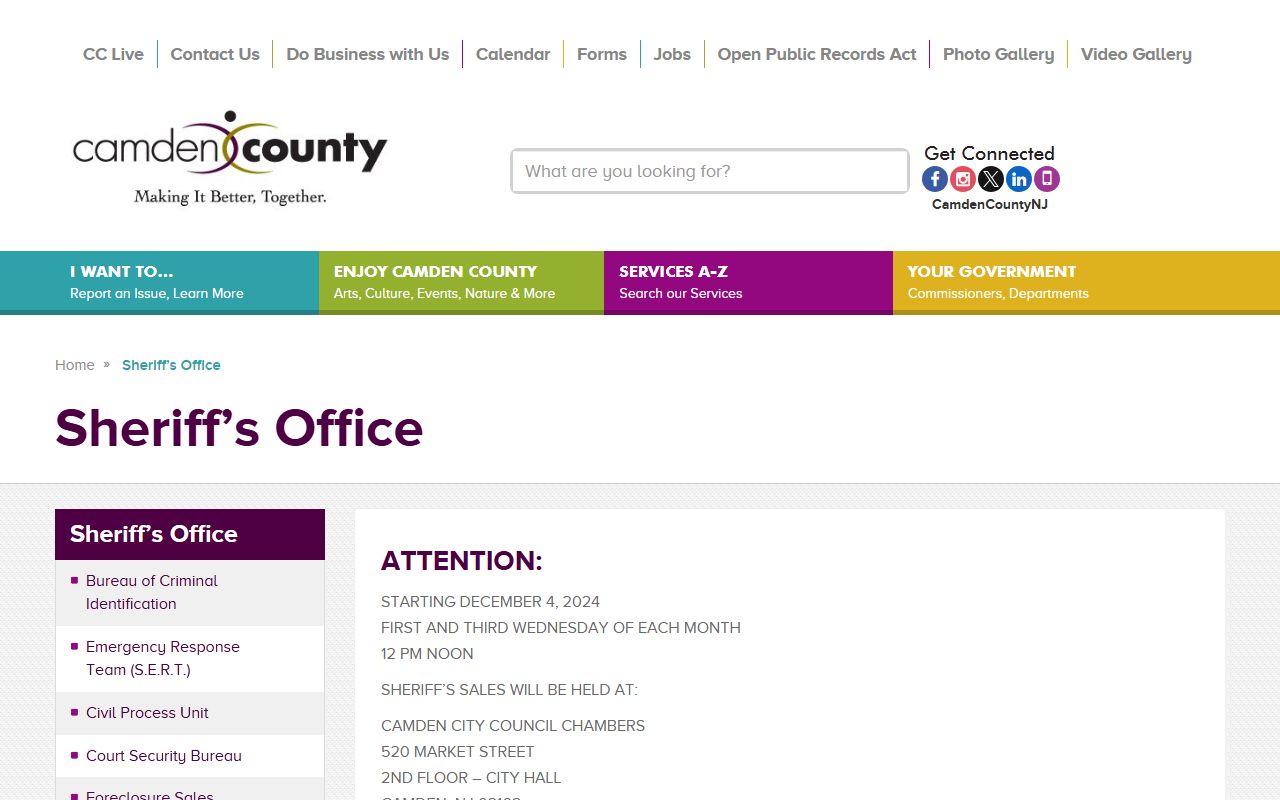
The bureau list on that page shows which unit does what, and the criminal identification bureau is the one tied most closely to arrest data. Sheriff Chuck Billingham leads the office, and his term runs from January 2025 through December 2027.
The official contact profile for Sheriff Chuck Billingham gives his term dates and the office address for the Camden County Sheriff.
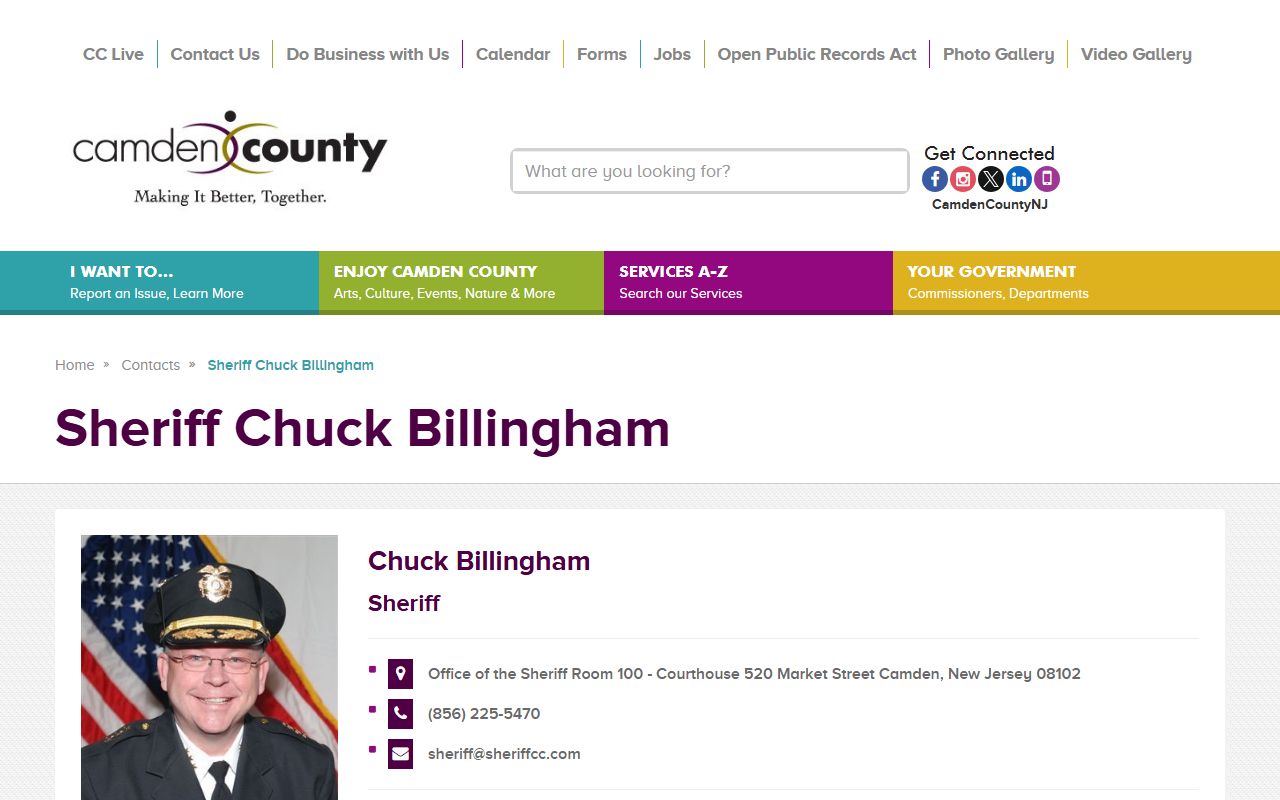
The sheriff's office works out of Room 100 in the county courthouse at 520 Market Street. The prosecutor sits a few blocks away and runs the charging decisions. Camden County Prosecutor Grace C. MacAulay leads that office, which handles serious criminal matters and accepts tips from the public.
The official profile for Prosecutor Grace C. MacAulay lists her biography, office address, phone, and tip email for the Camden County Prosecutor's Office.

The prosecutor's office took the lead on most felony cases that begin with a county arrest. For serious matters, the indigent defense side runs through the New Jersey Office of the Public Defender, while municipal cases use a municipal public defender. The two contact cards below give the direct addresses for each office.
Camden County Prosecutor
Grace C. MacAulay
Governor James J. Florio Center for Public Service
200 Federal Street
Camden, NJ 08103
(856) 225-8400
ccpotips@ccprosecutor.org
Camden County Sheriff's Office
Sheriff Chuck Billingham
Room 100, County Courthouse
520 Market Street
Camden, NJ 08102
Note: The county does not host a public web jail roster, so current booking and custody status come through the 24/7 corrections line at (609) 299-1694.
Arrest Records vs. Criminal Court Records
An arrest happens at booking. A court record begins later, when a prosecutor files charges. The two files answer different questions. An arrest record tells you who was taken in and on what alleged charges. A criminal court record tells you what the court did with the case. People often mix them up, but they come from different offices and update on different clocks.
| Arrest Record | Criminal Court Record | |
|---|---|---|
| Source | Sheriff, county police, jail | Superior Court Criminal Division |
| Created When | At booking, the moment of custody | When charges are filed in court |
| Contents | Booking info, arrest charges, mugshot, custody status | Indictment, pleas, motions, sentencing, disposition |
| Where to Find | Corrections phone line, Sheriff, Prosecutor | NJ Courts Find a Case |
For the full case history behind an arrest, the court file is the place to look. That side, including dockets and judgments of conviction, sits on the Camden County court dockets and court records pages.
Charges vs. Convictions in Camden County
Being charged is not the same as being convicted. A charge is an accusation. It means police or a prosecutor believe there is probable cause. A conviction is a judgment of guilt, reached by a plea or a verdict, and it carries a much higher burden of proof. An arrest can lead to charges that are later dropped, dismissed, or thrown out at trial. Reading an arrest record as proof of guilt is a common and costly mistake.
| Charge | Conviction | |
|---|---|---|
| Stage | Accusation at or after arrest | Final verdict or guilty plea |
| Burden of Proof | Probable cause | Beyond a reasonable doubt |
| Meaning | Case is alleged, not decided | Court found or accepted guilt |
| Public Record | Yes, unless sealed | Yes, unless expunged |
The outcome, called the disposition, is what matters most. A disposition can read dismissed, acquitted, guilty, or downgraded. Arrests that end without a conviction can often be expunged under state law, which is covered further down.
Mugshots and Booking Photos
A mugshot is the booking photo taken at intake. In Camden County, the jail and arresting agency hold these photos. The county does not post a public online gallery of booking photos in its official pages. Because there is no web roster, mugshots are not browsable the way some other counties offer. To confirm a booking, the 24/7 corrections line at (609) 299-1694 is the official channel for current custody status.
Mugshots can be part of an arrest record, but access is limited and tied to the record itself. They are not a public photo feed. If an arrest leads to a charged case, the court file does not normally carry the booking photo. The photo stays with the law enforcement record. For people later sent to state prison, the New Jersey Department of Corrections offender search shows a photo and custody data, and the inmate records page explains that tool.
Statewide Criminal Records Search
New Jersey runs a unified court system, so the public window into criminal cases is statewide, not county by county. The NJ Courts Find a Case page links the criminal case search and the criminal judgment search. Criminal cases can be searched by name or county, and picking Camden narrows the list. Criminal judgments can be searched by defendant name, SBI number, complaint number, or indictment number. The SBI number is the state identification number assigned to a person in the criminal justice system.
Camden's criminal records functions are based at the Hall of Justice. The NJ Courts criminal division records room page lists a Camden criminal records room at the Camden County Hall of Justice, 101 South 5th Street. That records room handles copy and inspection requests for Camden criminal case files. The table below shows what each public criminal search asks for, so you can match your identifier to the right tool before you begin.
| Search | Search by | Notes |
|---|---|---|
| Criminal cases | Name or county | Pick Camden County to narrow results. |
| Criminal judgments | Name, SBI, complaint, or indictment number | SBI is the state ID number. |
| Records room request | Case identifier and party name | Camden room at the Hall of Justice. |
Records moving through a municipal court, such as a disorderly persons complaint or a DUI ticket, are handled there. DUI and DWI matters often cross into criminal exposure, and the Camden County traffic court records page covers that overlap.
Expungement of Camden County Arrest Records
Expungement is the legal removal of arrest and criminal records from ordinary public access. Under New Jersey law, an expungement extracts, seals, impounds, or isolates the records held by courts, jails, law enforcement, and criminal justice agencies. It can cover complaints, warrants, arrests, fingerprints, photos, and docket records. A petition is filed in Superior Court, which is the same court system that handles Camden criminal cases. The 2019 reform expanded who qualifies and shortened some waiting periods.
The controlling statute is N.J.S.A. 2C:52, and the 2019 amendments appear in the official P.L. 2019, c.269 text. Arrests that did not lead to a conviction can often be expunged under N.J.S.A. 2C:52-6. Convictions are reviewed under other sections, with limits based on offense type, number of prior cases, and time elapsed. A petition must list every arrest, complaint, charge, and disposition tied to the person. Courts can deny a petition for ineligible offenses, pending charges, or public interest reasons.
A 2025 law added a free State Police portal where a person with an expungement order can check processing status. The change appears in P.L. 2025, c.38. The New Jersey State Police Expungement Unit handles the records side once an order is signed.
Sealed vs. Expunged Records
Sealing and expungement both hide records, but they are not the same. A sealed record still exists and can be opened by court order or for limited official use. An expunged record is treated as if it never existed in the eyes of the public, and even police access is sharply cut. The distinction matters when you check what a Camden County criminal records search will and will not show.
| Sealed | Expunged | |
|---|---|---|
| Visibility | Hidden from public inspection | Treated as if it never happened |
| Law Enforcement | Limited access | Very limited, isolated access |
| How It Happens | Court order under Rule 1:38 | Petition under N.J.S.A. 2C:52 |
| Eligibility | Set by court rule and judge | Based on offense type and waiting period |
Either way, the record drops out of a routine public search. To reopen a sealed file, a person usually files a motion in the court that holds it. To clear a record fully, the path is an expungement petition.
Restricted Criminal Records in Camden County
Some arrest and criminal records are closed to the public from the start. Juvenile records are the clearest example. Social, medical, legal, court, probation, and law enforcement records about a juvenile charged as delinquent are safeguarded under N.J.S.A. 2A:4A-60. Access is limited to courts, probation, prosecutors, attorneys, parents, and a few others named in the statute. A juvenile arrest does not show up in a routine public search.
The statutory text spells out how strictly these juvenile criminal records are guarded.
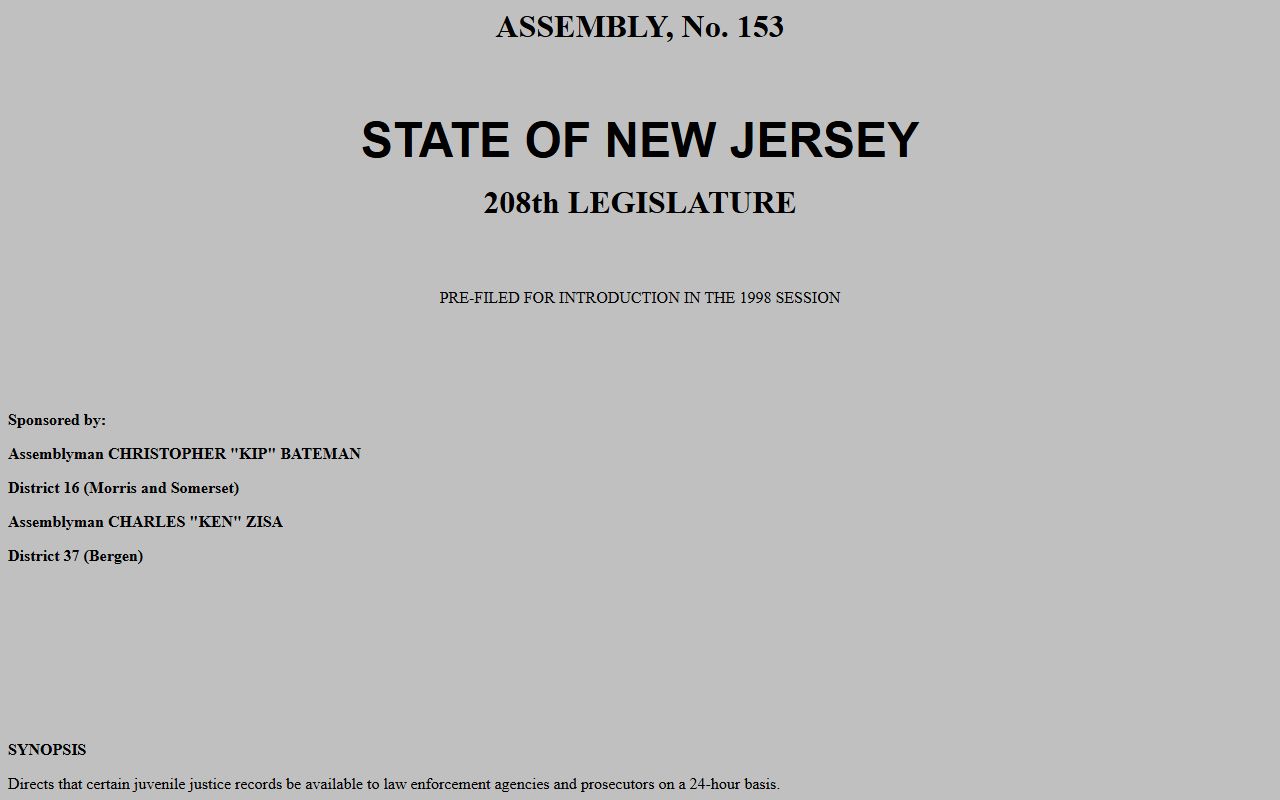
The bill text on the New Jersey Legislature site confirms the safeguards on juvenile records. The same closed-access logic applies to several other record types.
Other categories are restricted too. Expunged records are isolated under N.J.S.A. 2C:52. Ongoing investigations, grand jury materials, and certain victim and medical details are kept out of public view. Court access overall is governed by New Jersey Court Rule 1:38, which lists every exception. The county side of public records, by contrast, runs under the Open Public Records Act at N.J.S.A. 47:1A-1 et seq. A court case file does not become a county OPRA record just because the courthouse sits in Camden.
Background Check Considerations
A casual name search is not a legal background check. Public court searches and phone calls to the jail give a snapshot, but they are not certified and may miss sealed or expunged items. A formal background check for hiring, housing, or licensing must follow the federal Fair Credit Reporting Act, and it usually relies on fingerprints and a permitted purpose under state law. The two uses are very different, and treating a casual lookup as a vetting tool can break the law.
An arrest with no conviction should not be read as guilt. Charges get dropped. Cases get dismissed. Records get expunged. Always confirm the disposition through the court before relying on what an arrest record shows.
Important: Public record lookups are not FCRA consumer reports, so the results cannot be used for credit, employment, tenant, or insurance decisions.
Camden Crime Trends and Arrest Volume
Arrest volume tracks local crime, and Camden City has seen sharp drops. County officials reported that 2025 homicides fell to 12, down from 17 in 2024, the lowest total since 1985. Total crimes in the city fell to 3,120 in 2025, compared with 6,108 in 2012, a 49% drop. These numbers come from the Camden County Police Department, which is city police data, not court filing counts. Fewer crimes generally mean fewer arrests, which feeds into criminal complaints, court cases, and jail population.
The county tied the 2025 totals to a milestone in early 2026.

The January 2026 county crime release set out the homicide and violent crime figures for 2025. A later milestone followed that winter.
In March 2026 the county marked a first in half a century for the city.
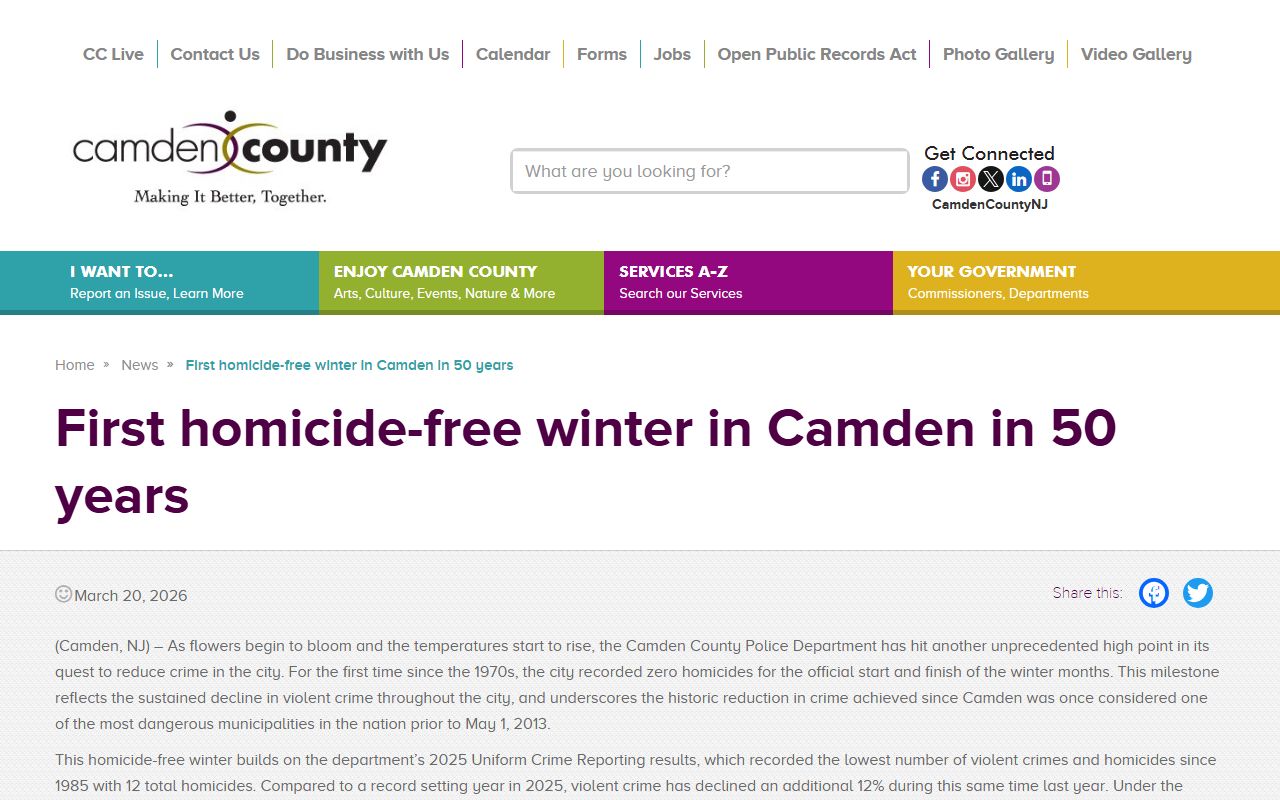
That homicide-free winter release described the first winter in 50 years without a homicide in Camden. These figures describe reported crime in the city, not the count of cases filed in Superior Court.